Colnaghi and Colnaghi Elliott Master Drawings are pleased to announce their participation in TEFAF Maastricht this March.
The presentation opens with a nineteenth-century Fang reliquary head (Añgokh-Nlô-Byeri) from Gabon, attributed to the Betsi group and mounted on a base by Kichizô Inagaki (1876–1951). These heads formed part of the byeri complex and acted as mediators between the living and ancestral remains preserved in bark containers. Early accounts describe the ritual handling of relics, including the removal of cranial fragments for propitiatory use, practices reflected in the deliberate abrasion visible on the sculpture’s facial features. With its elongated neck, incised coiffure and refined modelling, the work ranks among the finest Betsi examples to reach European collections. Its provenance through Paul Guillaume and inclusion in the Museum of Modern Art’s 1935 African Negro Art exhibition place it within the early canonisation of Central African sculpture.
Highlights also include Portrait of a Carmelite Monk by Alonso Cano, painted around 1644 and recently identified by Dr Benito Navarrete. Dating to Cano’s Valencian period following his departure from Madrid, the painting provides rare evidence of his activity as a portraitist. The sitter, a Calced Carmelite friar, is shown standing and turning toward the viewer. The work corresponds closely to portraits by Cano recorded by Palomino and later historians and expands the known corpus of his portraiture.
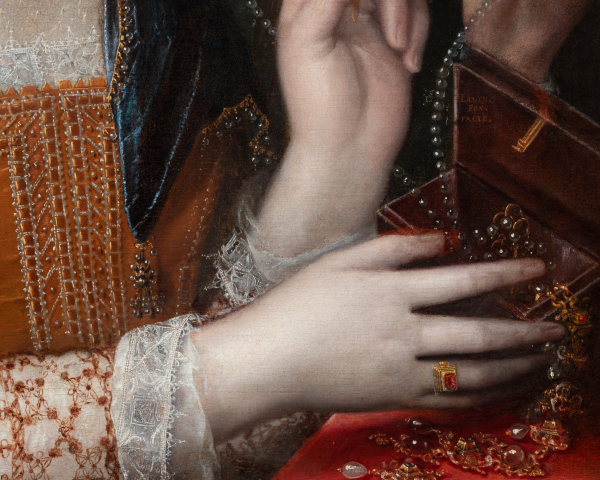
Another highlight is a recently rediscovered signed portrait by Lavinia Fontana, one of the earliest professional female painters in Europe. Trained in Bologna by her father Prospero Fontana, she established herself by the late 1570s as one of the city’s leading portraitists, supporting a large family through her practice before relocating to Rome at the invitation of Pope Clement VIII. The sitter, Isabella Ruini Angelelli, a Bolognese noblewoman known for her beauty and intellect, sat for Fontana on at least three other occasions, including Venus and Cupid (1592, Musée des Beaux-Arts de Rouen) and Portrait of Isabella Ruini Angelelli (1593, Palazzo Pitti, Florence). The present work expands the oeuvre of one of the most significant women painters of the late sixteenth century and further illuminates Fontana’s elite Bolognese clientele and her role within the city’s aristocratic circles.